Showing posts with label module 2. Show all posts

Monday, 18 January 2016

Why not both?


In The Guardian news article “The writing is on the paywall- but the end of the print is not quite nigh” it is reported that in Christmas 2012, it wasn’t print books that won out, or e-readers that won out.  It was both.  There are those who swear by print, and those who rejoiced at the release of e-readers.  Then there are those who simply like both.  There’s nothing quite like holding a book in your hand, turning the pages, flipping back and forth easily.  But for those of us who like to read, and who would carry multiple books with us where ever we could if they didn’t weigh so much, there’s the convenience of the e-reader, tablets, or even cellphones.  As someone who sees the importance of both, I believe there is something to be said about the results of sales at Christmas time.  Neither one can really replace the other.  There is value in print in cyber space, and there is value in hard copies.  It doesn’t matter if it’s a screen or a book, if something manages to capture my imagination, it’s not likely that I’m going to get distracted by anything else around me, or by anything else I could be doing in my immediate area.

Sheldon says. “It runs on the world’s most powerful graphics chip.  Imagination.”  He does this while playing a 80s text based game on his computer.  Despite being outdated, and long since replaced with newer games, with images, sounds, and characters you can control, he easily gets immersed in the game.  The way I see it, the key is imagination.  From text based games, to crystal clear graphics on Playstation or Xbox, or from books to e-readers, it’s really all about a readers, or participant’s imagination, interests, and how quickly something can pull them in.

The way we print text may have changed and evolved over time, but the concept remained the same.  Words, texts, images on paper, essentially finalized and bound together in our hand.  As Elizabeth Eisenstein states, “Premature obituaries of the death of the sermon and the end of the book are themselves testimony to long-enduring habits of the mind.” It’s not the end, it’s just another way of doing things, and there are those who are always going to circle back around to printed documents. “Yet the views held by previous generations cannot be deleted as easily as can words upon a screen.” There is almost a feeling of security with books. It you hit one wrong mistake, you won’t lose your content, if you throw your book across a room (I’ll fully admit I’ve done this, emotional response to whatever I was reading) the book is still going to be there, likely unharmed. While there are now clouds, and ways to back up the content we read on screens, it’s just not quite the same. Flipping it around, the e-readers offer books at a lower price, they don’t use paper, and you can bring more books with you wherever you go. These debates between the new and traditional can go on and on.

In the end, methods of communication are always evolving and changing, but I really do think there’s always room for more than one method.

References

Eisenstein, E. L. (1995). The end of the book?: Some perspectives on media change. The American Scholar, 541-555.

Preston, Peter, (2012). “The writing is on the paywall – but the end of print is not quite nigh,” The Guardian

Sunday, 17 January 2016

Module two – 19th Century Legacy

According to Elizabeth Eisenstein, Marshall McLuhan “was an omnivorous reader and crammed his text with citations taken from a vast variety of other books. Despite his affinity with nineteenth-century romanticists, he lacked the historical imagination of a Carlyle or a Michelet and made no effort to resurrect the multidimensional rich texture of life as it was lived in the past” (Eisenstein, 1995, p. 555).  I feel that this criticism is unjustified and contains at least one unwarranted assumption, which is that McLuhan lacked socio-historical imagination. Ironically, it is precisely McLuhan’s affinity with and perceptive knowledge of nineteenth-century romanticists, such as Alphonse de Lamartine (1790 – 1869), and their successors, such as Charles Baudelaire (1821-1867), that challenges at least part of Eisenstein’s criticism.

I would like to start with a methodological observation. In her article, “The End of the Book?: Some Perspectives on Media Change, Eisenstein builds an argument on a quote from Edmund Burke’s Reflections on the Revolution in France, who “complained that the age of chivalry was dead: ‘The age of chivalry is gone. That of sophisters, economists and calculators has succeeded and the glory of Europe is extinguished forever’ ” (Eisenstein, 1995, p. 546). She argues that “soon thereafter the age of chivalry received a literary resurrection in the novels of Walter Scott” and Victor Hugo (p. 546). She then makes a critical exploration of other related socio-cultural topics such as the influence of market forces on publishing, kitsch, literary fame, etc. Nineteenth-century writers like Théophile Gauthier, she argues, reacted strongly to some of these changes, including the impact of newspaper advertising. The argumentative strategy employed by Eisenstein in her article builds on a criticism made by an author (Burke) and demonstrates the thematic relevance of literary topics explored by subsequent writers (Scott, Hugo, Gauthier). This is exactly the type of argument that can be found in McLuhan. For example, his 1954 article “Joyce, Mallarmé and the Press starts with a thought-provoking 1831 quote from Alphonse de Lamartine, who is explaining to his editor why he declines to write for Revue Européenne*. Due to space constraints, I won’t delve into an in-depth analysis of this quote, but what is important to point out is that McLuhan builds on the central theme of the periodical press’s advent to analyze the effect that medium had on the production of books and the aesthetic concerns of James Joyce and Stéphane Mallarmé, as well as a number of other themes such as the relationship to and sense of time in modern literature, the impact of industrialization and the industrialized city and landscape on various art forms or that of Newtonian optics on poetry, etc. Simply put, Eisenstein and McLuhan present their ideas and make use of citations in a similar fashion.

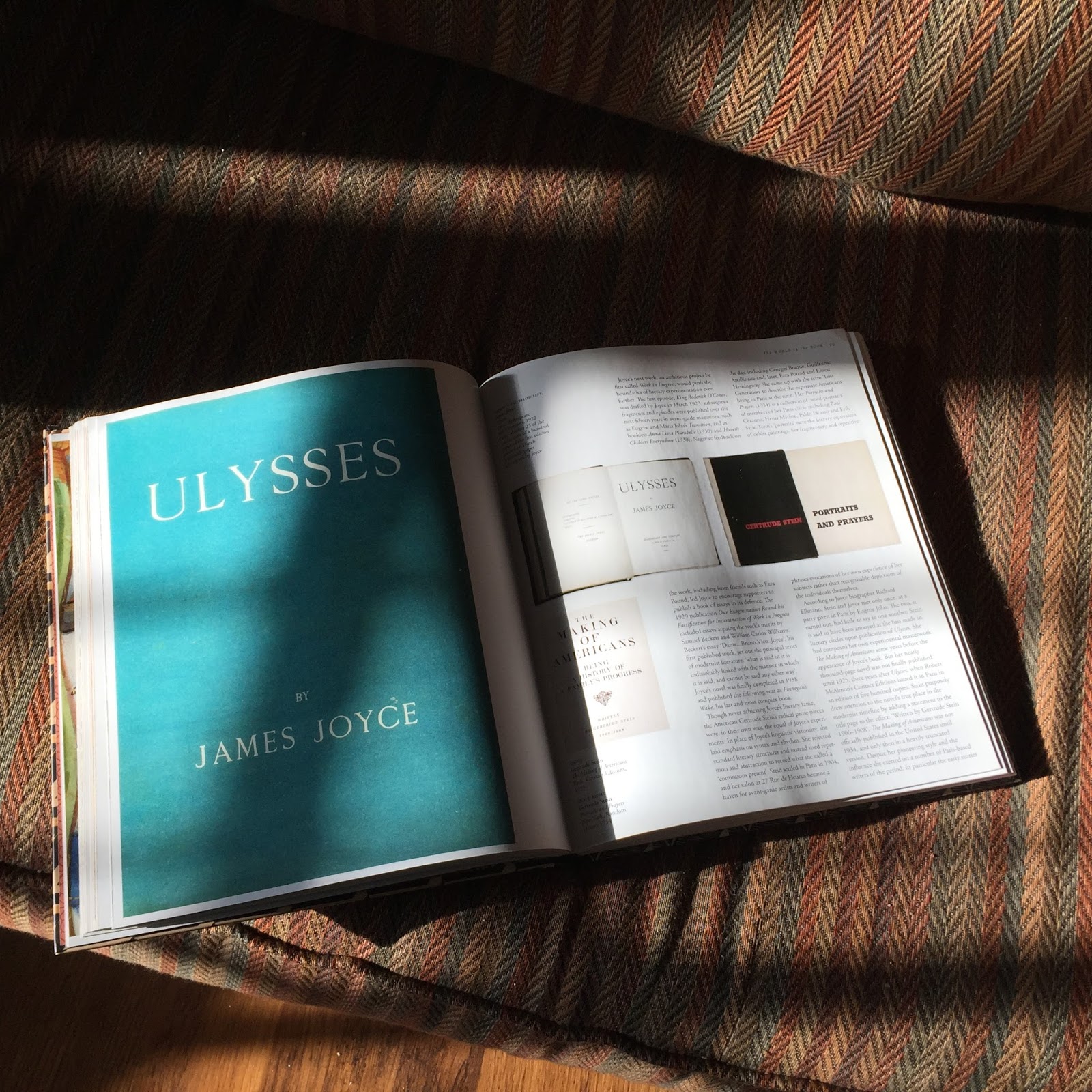
In the chapter in The World of the Book titled “The Modernist Experiment, Joyce and His Circle”, Cowley and Williamson sum up how “the extraordinary social changes brought about by industrialisation and urbanisation in the late nineteenth century set the scene for a dramatic revolution in the arts” (Cowley and Williamson, 2007, p. 71). Eisenstein puts forward a plausible hypothesis in her article “The End of the Book?”, which is that “twentieth-century painters experimenting with collage techniques may well have been influenced by the layout of [daily newspaper] front pages” (p. 553). Eisenstein’s premise could actually be applied even earlier to mid- to late- nineteenth-century French poets, like Baudelaire.

In her recently published “Baudelaire’s Media Aesthetic”, Marit Grøtta argues that montage is a “central feature of Baudelaire’s media aesthetics” (Grøtta, 2015, p. 147). According to Grøtta, Baudelaire’s “writing reconfigures space through decomposition of organic material and recomposition of the same material into something new. In this respect, he puts to use the key principle of the media of his day. […] Baudelaire’s writing experiments with kaleidoscopic vision and explores the forms and functions of the newspapers” (p. 147). Why do I bring this up? Because it is an observation that McLuhan also makes in “Joyce, Mallarmé and the Press” – “[…] it could be suggested that modern poetry with its elaborate mental landscapes owes much to the new pictorial technology which fascinated Poe and Baudelaire and on which Rimbaud and Mallarmé built much of their aesthetics” (McLuhan, 1954, p. 39).  More broadly, the influential essays by Walter Benjamin on life as it was experienced in Paris by the literary leaders of the nineteenth century go into great detail about the impact of the advent of newspapers on everyday life, politics, the literary establishment, etc. Furthermore, in his seminal essay, “The Work of Art in an Age of Mechanical Reproduction (1936), he discusses the influence of the technical/technological on artistic reception and practice. Literary critic Sven Birkerts concludes his book The Gutenberg Elegies with an insightful discussion on the relevance of Benjamin’s ideas for today’s technologically-dominated society (Birkerts, 1994, p. 224-229), a reading that complements ideas found in the articles by both Eisenstein and McLuhan. 

My knowledge of Marshall McLuhan’s writing is too limited to discuss Eisenstein’s criticism with respect to his ability to “resurrect the multidimensional rich texture of life as it was lived in the past” (Eisenstein, 1995, p. 555). However, while re-reading his short, erudite analysis of the Sherlock Holmes character in his 1951 Mechanical Bride, I could not help but think that McLuhan’s understanding of nineteenth-century literature appears to be still relevant today, in terms of contributing to a better understanding of the massive cultural impact of technological revolutions.

*Two digitized copies of 1831 editions of Revue européenne can be found here.


A picture of the pages 74 and 75 of Cowly's and Williamson's gorgeous book 
"The World of the Book"


References

Benjamin, W. (2006). The writer of modern life: essays on Charles Baudelaire; M. W. Jennings (Ed.), H. Eiland [et al.] (Tr.). Cambridge: Harvard University Press

Birkerts, S. (1994). The Gutenberg Elegies: The Fate of Reading in an Electronic Age, Boston: Faber and Faber

Cowly, D. & Williamson, C. (2007). The modernist experiment: Joyce and his circle. In The World of the Book (pp. 71-78). Melbourne: The Miengunyah Press

Grøtta, M. (2015). Baudelaire’s Media Aesthetics: The Gaze of the Flâneur and 19th Century Media. London: Bloomsbury Publishing Inc.

McLuhan, M. (1954). Joyce, Mallarmé and the Press, The Sewanee Review, 62 (1), 38-55

McLuhan, M. (1995). From Da Vinci to Holmes/ The Mechanical Bride (1951). In E. McLuhan & F. Zingrone (Eds.), Essential McLuhan (pp. 30-34). Toronto: Anansi Press Ltd.

The Same as it Ever Was

The Same As it Ever Was: Permanence in Technological Chaos

Good golly, it's like it's actually happening to me!

Sheldon is battling Trolls and solving puzzles on an 80s era text-based adventure game. Though he initially frames it as nostalgia to his roommate, it quickly escalates to engagement that is immediate, urgent, and authentic. The game is old and outdated, but it still has impact. Decades after its creation it remains a perfect manifestation of its original intent. Form and function are in balance and are able to provoke response.

Though the scenario is sitcom fiction, the complex and confounding interplay between technology, text, and what it means to be outmoded or obsolete seem to ring true. Which brings us to the book.

Wednesday, 13 January 2016

The History of Book: Module Two reaction


As Eisenstein so eloquently writes, the literati always seem eager to predict the demise of the book. In the 19th century, when newspapers were gaining dominance in England, they engaged in a certain amount of hubris. Eisenstein quotes an editorial from the London Times from 1852, which states:
"Daily appealing to the enlightened force of public opinion; antici-
pating when possible the march of events, standing upon the breach
between past and future, extending its survey to the horizon of the
world, journalism was now truly an estate of the realm more powerful
than any other estate" (p. 555).
Given the economics pressures suffered by newspapers now, I find this quite humorous.

I'm also realizing how my understanding of the book are thoroughly Western. While the texts from Module Two give examples from Ancient Egypt, 18th century France and 20th century America, I wonder how understandings of the book differ in other cultures.

Indeed, many modern scripts are read right-to-left or top-to-bottom; Hebrew, Chinese, and Arabic to name a few. While Bonnie Mak explains the origin of "paginae" in Egypt, she omits any mention of other literary traditions (p. 11). I'm assuming then that her thesis on the page pertains solely to the English language. I'm sure there's endless scholarship in these areas and I wish I had more time to explore the topics.

I appreciate Mak's thoughts about "the edges of the cognitive spaces of the page" (p. 13). While she writes specifically about wax tablets used in Egypt, it's no different than smartphone and tablets used today.

Mak also notes a graphic design principle that is still used today: the use of blank space (p. 17). The ability to add extra space with margins and gutters is well integrated into modern desktop publishing software.

To me, this is analogous to the use of pauses in radio stories. As a producer, pauses are used to give the audience a space to breathe. It allows them time to digest one concept, before hearing another. Perhaps an example of a transliteracy in action?

I can't predict the future of the book, but only observe how I engage with texts. I read this week's texts on my phone, skipping between various apps to annotate and research. Despite my avowed status as a technophile, I want to print out these readings so that I can physically interact with them. So far, I have been able to resist this urge, but we will see how I do as this course progresses.

Elizabeth, E. (1995). The End of the Book? Some Perspectives on Media Change. American Scholar, 64541-555.

Mak, B. (2011). “How the Page Matters,” https://drive.google.com/file/d/0BzsIVysTrCWkT1FaN0lpMmVkY28/view?usp=sharing

Monday, 11 January 2016

Nostalgia is powerful: a reaction to Eisenstein


Nostalgia is a power feeling.

The Big Bang Theory's Sheldon is overwhelmed with the nostalgic appeal of text-based games.  Humans are sentimental creatures, so as long as we can remember a world before iPods and Instagram, we will yearn for it.

The idea that new developments will always supersede older technology is an oversimplification. While technology companies like Apple work in planned obsolescence, they can not totally control the whims of the consumer.

The willingness of companies to pander to this nostalgia is evident in pop culture trends. Look no further than Netflix's revival of Full House, The Magic School Bus and Gilmore Girls. It's not just TV production companies that are cashing in. Check out how one company is resurrecting Hydrox cookies.

In Eisenstein's words, "long-enduring habits of mind" keep us in this loop of re-invention. It's not hard to find evidence of this. Indeed, in these first weeks of 2016, people across North America are pledging to shed their old skins, totally forgetting how they failed those same resolutions a year ago.

As Elizabeth Eisenstein alludes, since the invention of the Kindle, futurists have been heralding the end of print books. However, statistics from December 2015 show that sales of the e-book are leveling out while sales of print books are trending upwards.

References:

Kestenbaum, D. [producer]. (2015, September 18). Episode 652: The Hydrox Resurrection. Retrieved January 11, 2016, from http://www.npr.org/sections/money/2015/09/18/441546748/episode-652-the-hydrox-resurrection.

Regan, M.D. (2015, December 15).Why print book sales are rising, and books are getting longer. Retrieved January 11, 2016, from http://www.csmonitor.com/Books/2015/1221/Why-print-book-sales-are-rising-and-books-are-getting-longer.

TheDeepEnd666. (2011, April 1). Big bang theory - Sheldon playing text adventures (video file). Retrieved January 11, 2016, from https://www.youtube.com/watch?v=YCpr_QHAqks.