Fortunately I was able to see him, and have a very good conversation, a week before he passed away. It still made the searching for articles, videos and other media about conversations about dying more meaningful for me, as well as frankly a bit painful. I went from the large academic concept of trying to inspire more Canadians to have conversations about death; to personally losing someone who had inspired me through decades.
My first efforts were to set up a Pinterest page on which I began gathering posts about the importance of conversations about death, and the difficulty of building momentum about an issue like this.
It’s hard to get public attention for complex issues like this, especially when there is such a diverse range of communication channels and issues competing for attention (Cadwalladr, 2013; Juris, 2012). My next step was to create a community petition on avaaz.org calling for the Canadian government to declare a national day for end of life conversations.
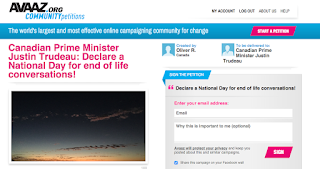
Just as I
was starting to promote my petition via social media and emails, I realized I
had a technical issue: the link to my petition was frozen with a reference to
May 5th. I wanted to remove this date and leave the choice of the
date to the participants, but there was no way to edit the URL. Eventually I
wrote an email to the avaaz.org technical support team, but at the time of
writing this I have not had a reply. Rather than focus on this petition, which
I will likely pull down shortly, I turned my attention to look for other petitions
and civic engagement projects related to palliative care.
Many projects
related to assisted suicide, like a projected called Dying with Dignity
Canada, which collected over 3000 pledges in an effort to lobby the Canadian
government to allow physician assisted suicide.

In fact, there were so many sites talking about aspects of assisted dying that it appears that the key activists may have been diffusing their capacity to reach political goals. As Juris points out:
it is also exceedingly difficult, even for seasoned
activists, to keep up with the sheer number and diversity of
communication channels, including myriad Twitter feeds,
working-group listservs and forums... (2012, p. 271)
Here is a petition that also fell short of its goal, but reached over 75,000 signatories:

Other resources included YouTube videos explaining the steps
to creating advance care plans which is a constructive way to inform stakeholders:
Steven Cave - TED talk: The 4 stories we tell ourselves about death.
Looking more broadly, researchers have shown that social media tools allow for the mobilization and coordination of individuals to coordinate protest or political activism (Juris, 2012; Marichal, 2013).
Both avaaz.org and change.org have very strong profiles of success stories, including making impacts on everything from Internet neutrality:

Source: www.avaaz.org
…to adding
women to the Canadian dollar:

Source: www.change.org
For a period of time many researchers questioned the effectiveness of online campaigns in creating real and lasting social change (Christianson, 2011; Hindman, 2009; Putnam, 2000; Shulman, 2005). I wonder if this might be in the midst of changing, as capacity to use these digital tools for mass mobilization on social issues improves. Much of the research that these authors would have used would pre-date the creation of platforms like change.org and avaaz.org which were both created in 2007 and now have huge followings, approximately 140 million and 43 million respectively.
-------------------------
References:
Cadwalladr, C. (2013). Inside Avaaz – Can Online Activism Really Change the
World? The Guardian, Retrieved from:
http://www.theguardian.com/technology/2013/nov/17/avaazonlineactivismcanitchanget
heworld
Cave, S. (2013, July 21). Steven Cave: The 4 stories we tell ourselves about death. [Video file]. Retrieved from http://www.ted.com/talks/stephen_cave_the_4_stories_we_tell_ourselves_about_death
Fowler, R., & Hammer, M. (2013). End-of-life care in Canada. Clinical & Investigative Medicine, 36(3), 127-132.
Juris, J. S. (2012). Reflections on #Occupy Everywhere: Social media, public space, and emerging logics of aggregation. American Ethnologist, 39(2), 259-279.
Marichal, J. (2013). Political Facebook groups: Micro-activism and the digital front stage. First Monday, 18(12). doi:10.5210/fm.v18i12.4653
Mayer, A. (2015). Does social media help or hinder political debates? CBC News. Retrieved from: http://www.cbc.ca/news/politics/canada-federal-election-social-media-1.3239051
Sommers, J. (2015). Change.org's 10 Biggest Victories As Petition Website Celebrates 100 Million Users. Huffington Post. Retrieved from: http://www.huffingtonpost.co.uk/2015/06/22/changeorg-successful-petitions_n_7635750.html

