Here is the wordle for Sue Thomas’ piece “Next nature: ‘nature caused by people’”. I’ve made all the words lowercase and applied the ‘moss’ colour scheme, lending a more ‘organic’ feel to the graphic. Nature dominates, but the eye is drawn to mishmash of the natural and the (human) constructed: world, science, design, technology, meat, plants, grow, etc. as well as the ambiguous and intriguing ‘next’. Looking deeper, the pattern continues with more specific language. It’s our natural environment and human activity all mashed up, big and small. Nature dominates, but human activity surrounds it, filling every nook and cranny.
I chose the article "Study: Relaxing Video Games Make People Kinder."
Had I not read the article before creating the image, I would have assumed that this was some sort of study on the impacts of students playing video games. But I would not have assumed that 'kinder' was the focus. Maybe people play games to relaxed, violent or not. In this word map "violent" is easier to spot than "nonviolent" in both size and colour. Red is often associated with war, blood, fire and violence, gray is emotionless and dull, and black with power and death. In no way would I have assumed this was connected to a study involving calming video games featuring the ocean.
Moore, E. (2011). “Study: Relaxing Video Games Make People Kinder,” CNet,http://www.cnet.com/news/study-relaxing-video-games-make-people-kinder/
Daniel B. Smith's article "Is There an Ecological Unconscious?" serves as an introduction to ecopsychology (2010). Some useful vocabulary explained in the piece:
Glenn Albrecht's definition of "solastalgia" as "the pain experienced when there is recognition that the place where one resides and that one loves is under immediate assault . . . a form of homesickness one gets when one is still at ‘home’” (cited in Smith, 2010),
Ecopsychology as a "psychological subfield" that posits that "grief, despair and anxiety are the consequences of dismissing equally deep-rooted ecological instincts" (Smith), and
E.O. Wilson's definition of "biophilia" as the "innate tendency to focus on life and lifelike processes" (cited in Smith).
Certainly, the words that are emphasized in the above graphic emphasize the concepts behind these definitions. On the side of "nature", falls similar words: "environmental", "ecological" and "environment". On the side of "psychological", falls "ecopsychology", "psychologist", "therapeutic" and "health".
Without reading "Is There an Ecological Unconscious?", from this graphic I would assume that the article discusses the intersection of nature and psychology.
References
Smith, D. B. (2010, January 27). "Is There an Ecological Unconscious?" The New York Times. Retrieved March 21, 2016, from http://www.nytimes.com/2010/01/31/magazine/31ecopsych-t.html.
It has never been easier to create a petition. Platforms such as Avaaz.com and Change.org make it drop dead simple to assemble the basic components of a petition and to create a ready-made product that is shareable and interactive (to the extent that adding your name and allowing for comments is interactive). The technology is easy. The other stuff is hard.
March 21: Choose any of the readings from this module and paste it into Wordle.net. Save and embed the Wordle tag cloud in a blog post. Write a few points about what you notice: what has the tag cloud highlighted? Does it align with your interpretation?
March 25: Having read the excerpt on Amazon of Sue Thomas’s “An Enormous, Unbounded World,” ask Sue a question about what you’ve read. Send your tweet or tweets to both @suethomas and @JessL
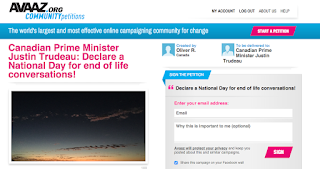
In this exercise I chose an issue that I think is a challenge to many people in Canada: having timely conversations about dying. This experience has been very multilayered for me, exploring questions of new media narratives overlapping with facing personal challenges. In mid-February, essentially in the middle of this project, a very important mentor and friend of mine passed away.
Fortunately I was able to see him, and have a very good conversation, a week before he passed away. It still made the searching for articles, videos and other media about conversations about dying more meaningful for me, as well as frankly a bit painful. I went from the large academic concept of trying to inspire more Canadians to have conversations about death; to personally losing someone who had inspired me through decades.
My first efforts were to set up a Pinterest page on which I began gathering posts about the importance of conversations about death, and the difficulty of building momentum about an issue like this.
Just as I
was starting to promote my petition via social media and emails, I realized I
had a technical issue: the link to my petition was frozen with a reference to
May 5th. I wanted to remove this date and leave the choice of the
date to the participants, but there was no way to edit the URL. Eventually I
wrote an email to the avaaz.org technical support team, but at the time of
writing this I have not had a reply. Rather than focus on this petition, which
I will likely pull down shortly, I turned my attention to look for other petitions
and civic engagement projects related to palliative care.
Many projects
related to assisted suicide, like a projected called Dying with Dignity
Canada, which collected over 3000 pledges in an effort to lobby the Canadian
government to allow physician assisted suicide.
In fact, there were so many sites talking about aspects of assisted dying that it appears that the key activists may have been diffusing their capacity to reach political goals. As Juris points out:
it is also exceedingly difficult, even for seasoned
activists, to keep up with the sheer number and diversity of
communication channels, including myriad Twitter feeds,
working-group listservs and forums... (2012, p. 271)
Here is a petition that also fell short of its goal, but reached over 75,000 signatories:
Other resources included YouTube videos explaining the steps
to creating advance care plans which is a constructive way to inform stakeholders:
Steven Cave - TED talk: The 4 stories we tell ourselves about death.
Looking more broadly, researchers have shown that social media tools allow for the mobilization and coordination of individuals to coordinate protest or political activism (Juris, 2012; Marichal, 2013).
Both avaaz.org and change.org have very strong profiles of success stories, including making impacts on everything from Internet neutrality:
Source: www.avaaz.org
…to adding
women to the Canadian dollar:
Source: www.change.org
For a period of time many researchers questioned the effectiveness of online campaigns in creating real and lasting social change (Christianson, 2011; Hindman, 2009; Putnam, 2000; Shulman, 2005). I wonder if this might be in the midst of changing, as capacity to use these digital tools for mass mobilization on social issues improves. Much of the research that these authors would have used would pre-date the creation of platforms like change.org and avaaz.org which were both created in 2007 and now have huge followings, approximately 140 million and 43 million respectively.
To conclude, this exploration of online activism has helped me experience some of the challenges of creating campaigns, as well as some of the successes that might arise. This is a very rapidly evolving area of research, and it will be interesting to engage in the next phases of it!
-------------------------
References:
Cadwalladr, C. (2013). Inside Avaaz – Can Online Activism Really Change the
World? The Guardian, Retrieved from:
http://www.theguardian.com/technology/2013/nov/17/avaazonlineactivismcanitchanget
heworld
Cave, S. (2013, July 21). Steven Cave: The 4 stories we tell ourselves about death. [Video file]. Retrieved from http://www.ted.com/talks/stephen_cave_the_4_stories_we_tell_ourselves_about_death
Fowler, R., & Hammer, M. (2013). End-of-life care in Canada. Clinical & Investigative Medicine, 36(3), 127-132.
Juris, J. S. (2012). Reflections on #Occupy Everywhere: Social media, public space, and emerging logics of aggregation. American Ethnologist, 39(2), 259-279.
Marichal, J. (2013). Political Facebook groups: Micro-activism and the digital front stage. First Monday, 18(12). doi:10.5210/fm.v18i12.4653
Mayer, A. (2015). Does social media help or hinder political debates? CBC News. Retrieved from: http://www.cbc.ca/news/politics/canada-federal-election-social-media-1.3239051
Sommers, J. (2015). Change.org's 10 Biggest Victories As Petition Website Celebrates 100 Million Users. Huffington Post. Retrieved from: http://www.huffingtonpost.co.uk/2015/06/22/changeorg-successful-petitions_n_7635750.html
My petition is specifically about Metro’s Fiscal 2017 Budget
and the need to prioritize increased frequency on key bus routes. In addition,
I urge Metro to prioritize capital investments to decrease headways on the
rails. Take a look, and sign here.
Developing this petition felt second nature to me, as my
previous post was in advocacy work, and the readings provided a critical
scaffold around my own personal activism. In my professional life, mobilization
and advocacy toward social change, felt increasingly seamless between on and
offline experiences.
I began in D.C. as a digital manager for a small advocacy
shop in 2005, and at that time, we still had a fax blast system that sent
legislative alerts to local chapters to prompt call-ins, petitions, and letter-writing.
We had also developed an active email list, and soon introduced online letter
submission to congressional officials. Kreiss’ (2012) piece about the
digitization of Obama’s voter mobilization strategies provided fascinating
depth and contour to their work, but the findings were not surprising, per se.
I think the most valuable takeaway, was the deliberateness
with which he found the campaign identified and cultivated key behaviors from
targeted audiences—the criteria for each would be idiosyncratic, it seems; but
their matrix of media, based on “audience size and demographics,” informed the
navigation of those political networks who made up the electorate, both in the
priamries and the general election.
I selected the LA Metro as the social change I wanted to
pursue, because, as a new resident of Los Angeles, I am surprised at how
infrequently the buses run. I even grew up in Ottawa, with a much smaller
population base, and found its standard of service to be higher. Californians
are seemingly on a rail kick specifically because of traffic congestion. For
some amateur history of public transit in LA:
Even though a few of the articles point to significant
challenges that online activists can have in making true social change (Rainie
2012; Cadwalladr, 2013; Wihbey, 2013) I have also attended the very service
council meetings where budget recommendations are offered to the Metro staff.
Attendance is low for routine business like an annual budget; though my sample
is admittedly only three meetings ever. Cadwalladr’s and Rainie’s conclusions
suggest that the fragmentation and deeper focus of specific initiatives on
social media are necessarily tied to the potential impact of these activist
efforts. This resonates on my own experiences in DC, where advocates and
individual calls or emails regularly upended policy proposals and, as research
showed, in fact overwhelmed public officials (Fitch & Goldsmith, 2005).
So for my petition, I chose a narrow focus, where I knew my
meager set of signatories would potentially have an impact on the Metro budget
committee’s decisions.
Fitch, B. and Goldsmith, K. (2005). Communicating with
congress: How capitol hill is dealing with the surge in citizen advocacy. Congressional Management Foundation. Retrieved
fromhttp://www.congressfoundation.org/component/content/article/63
Kreiss, D. (2012). Acting in the public sphere: The 2008
Obama campaign’s strategic use of new media to shape narratives of presidential
race. Research in Social Movements,
Conflicts, and Change, 33, 195-223. Retrieved from http://www.emeraldinsight.com/doi/abs/10.1108/S0163-786X(2012)0000033011
Wihbey, J. (2013, March 5). Pew research: Twitter reaction
to events often at odds with overall public opinion. Journalist’s Resource: Research on Today’s News Topics.