Showing posts with label Oliver Rossier. Show all posts

Saturday, 19 March 2016

Assignment 5: Online Activism - End of Life Conversations

In this exercise I chose an issue that I think is a challenge to many people in Canada: having timely conversations about dying. This experience has been very multilayered for me, exploring questions of new media narratives overlapping with facing personal challenges. In mid-February, essentially in the middle of this project, a very important mentor and friend of mine passed away.

Fortunately I was able to see him, and have a very good conversation, a week before he passed away. It still made the searching for articles, videos and other media about conversations about dying more meaningful for me, as well as frankly a bit painful. I went from the large academic concept of trying to inspire more Canadians to have conversations about death; to personally losing someone who had inspired me through decades.

My first efforts were to set up a Pinterest page on which I began gathering posts about the importance of conversations about death, and the difficulty of building momentum about an issue like this.

It’s hard to get public attention for complex issues like this, especially when there is such a diverse range of communication channels and issues competing for attention (Cadwalladr, 2013; Juris, 2012). My next step was to create a community petition on avaaz.org calling for the Canadian government to declare a national day for end of life conversations.
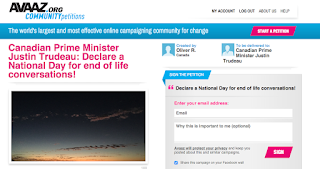

Just as I was starting to promote my petition via social media and emails, I realized I had a technical issue: the link to my petition was frozen with a reference to May 5th. I wanted to remove this date and leave the choice of the date to the participants, but there was no way to edit the URL. Eventually I wrote an email to the avaaz.org technical support team, but at the time of writing this I have not had a reply. Rather than focus on this petition, which I will likely pull down shortly, I turned my attention to look for other petitions and civic engagement projects related to palliative care.

Many projects related to assisted suicide, like a projected called Dying with Dignity Canada, which collected over 3000 pledges in an effort to lobby the Canadian government to allow physician assisted suicide.

In fact, there were so many sites talking about aspects of assisted dying that it appears that the key activists may have been diffusing their capacity to reach political goals. As Juris points out: 
it is also exceedingly difficult, even for seasoned
activists, to keep up with the sheer number and diversity of
communication channels, including myriad Twitter feeds,
working-group listservs and forums... (2012, p. 271)

Here is a petition that also fell short of its goal, but reached over 75,000 signatories:

Other resources included YouTube videos explaining the steps to creating advance care plans which is a constructive way to inform stakeholders:


Steven Cave - TED talk: The 4 stories we tell ourselves about death.


Looking more broadly, researchers have shown that social media tools allow for the mobilization and coordination of individuals to coordinate protest or political activism (Juris, 2012; Marichal, 2013).

Both avaaz.org and change.org have very strong profiles of success stories, including making impacts on everything from Internet neutrality:

Source: www.avaaz.org


…to adding women to the Canadian dollar:

Source: www.change.org

For a period of time many researchers questioned the effectiveness of online campaigns in creating real and lasting social change (Christianson, 2011; Hindman, 2009; Putnam, 2000; Shulman, 2005). I wonder if this might be in the midst of changing, as capacity to use these digital tools for mass mobilization on social issues improves. Much of the research that these authors would have used would pre-date the creation of platforms like change.org and avaaz.org which were both created in 2007 and now have huge followings, approximately 140 million and 43 million respectively.

To conclude, this exploration of online activism has helped me experience some of the challenges of creating campaigns, as well as some of the successes that might arise. This is a very rapidly evolving area of research, and it will be interesting to engage in the next phases of it!
-------------------------
References:

Cadwalladr, C. (2013). Inside Avaaz – Can Online Activism Really Change the
World? The Guardian, Retrieved from:
http://www.theguardian.com/technology/2013/nov/17/avaazonlineactivismcanitchanget
heworld

Cave, S. (2013, July 21). Steven Cave: The 4 stories we tell ourselves about death. [Video file]. Retrieved from http://www.ted.com/talks/stephen_cave_the_4_stories_we_tell_ourselves_about_death

Fowler, R., & Hammer, M. (2013). End-of-life care in Canada. Clinical & Investigative Medicine, 36(3), 127-132.

Juris, J. S. (2012). Reflections on #Occupy Everywhere: Social media, public space, and emerging logics of aggregation. American Ethnologist, 39(2), 259-279.

Marichal, J. (2013). Political Facebook groups: Micro-activism and the digital front stage. First Monday, 18(12). doi:10.5210/fm.v18i12.4653

Mayer, A. (2015). Does social media help or hinder political debates? CBC News. Retrieved from: http://www.cbc.ca/news/politics/canada-federal-election-social-media-1.3239051

Sommers, J. (2015). Change.org's 10 Biggest Victories As Petition Website Celebrates 100 Million Users. Huffington Post. Retrieved from: http://www.huffingtonpost.co.uk/2015/06/22/changeorg-successful-petitions_n_7635750.html


Tuesday, 8 March 2016

Theory of a Selfie

A lot more than just sharing a smile or frown, the power of the selfie ranges from personal to politics to economics to global.

Selfies have been defined by Oxford Dictionaries as photograph(s) that one has taken of  oneself, typically one taken with a smart phone or webcam and uploaded to a social media website (n.d.).

On the personal side, I’ve been taking selfies for many years, mostly to capture myself in a particular context and share it or remember it; but during my MACT studies I’ve come to recognize that there are many layers of self-representation, identity and production involved with even something that appears to be as simple as a selfie. There is an implicit connection with the fact that selfies are often generated to share – to invoke an outside perspective on ourselves (Horning, 2014).

Here’s a selfie I took against the side of a building, playing with the concept of externalizing a selfie:


A shadow of a selfie, curved around a building in the sunrise, with the full moon setting in the distance. Layering my static identity (Horning, 2014) on the brickwork, with sunlight and moonlight coming from different directions.

Speaking of different directions, the political use of selfies has certainly gone in different directions in North America.

Justin Trudeau has been called the ‘selfie king of Canada’ (Francis, 2015) and the last Canadian election was described by some as the ‘selfie election’ (McDiarmid, 2015). Trudeaus capacity to engage with a seemingly endless stream of selfie posing has brought him praise and criticism (McDiarmid, 2015; Maloney, 2015; ). Here is a CBC video where he repeatedly models with charm:

One of the concepts that a selfie evokes is a proximately and closeness to the subject, and many politicians want to create the impression of closeness to their audience especially during elections… During funerals is another story!

Photo Credit: Roberto Schmidt, Agence France-Presse

This is the photo from Nelson Mandela’s funeral ceremony in December 2013 that sparked the Selfiegate scandal, from left to right: David Cameron, Helle Thorning-Schmidt, Barack Obama, Michelle Obama.  It was a pivotal moment for the evolving social discussion about when it is acceptable to take selfies and where. “It was not just three world leaders taking a selfie; it was three world leaders taking a selfie at a memorial service for an internationally beloved human rights leader” (Miltner & Baym, p. 1705). As the scandal about this photo unfolded, it became a conversation about whether or not society was ready to accept this kind of behaviour at formal functions like funerals. In the end, this particular event had many narratives and generated a series of important questions about contextualizing power and identity and use of mobile technology (Farci & Orefice, 2015; Miltner & Baym, 2015):
  • Should political leaders be held to different standards in their use of mobile technology?
  • How do we normalize having leaders of all genders interacting in public spheres?
  • What are the interactive power dynamics between social media and main-stream media?

Interestingly, one of the possible outcomes of this media scandal was Obama’s recent request not to have selfies taken with him (Reilly, 2016). Publishing selfies is quite simple using social media platforms, but they can quickly take on a life of their own and overcome the initial representation that the producers intended. Perhaps Obama tired of worrying how his engagement in selfies would affect the public’s overall perception of him as a leader.
So the use of selfies by the leaders of Canada and the United States has gone in different directions – taking a global

One project that examines selfies at a macro-level is Lev Manovich’s selfie-city, which looked at the selfies generated in 5 cities around the world. I found this very intriguing for a number of reasons, including that they openly released their data and methodology, essentially creating the capacity for future research building on this project. The use of dynamic imagery, scrolling images, graphs and charts related to the diverse set of findings helps explore and compare the use of selfies in specific contexts.

Here is one of the selfies from the dataset (http://selfiecity.net/selfiexploratory/):


Taking the question of selfies even more broadly, of the largest projects related to selfies must be by NASA who in 2014 combined over 36,000 selfies to create this image:


This project demonstrated a number of different things for NASA including the sheer computing power that they can wield. The total size of the photo is 3.2 giga-pixels, or 1000 times more information than an average size photo, and to make things even more complicated the thousands of selfies were mapped onto an image of the current weather patterns. As a communicative device, this macro-photo also demonstrated the appeal that NASA has to a global audience, there were submissions from over 100 countries. In terms of the roles of producer, creator, consumer; this image also represents a deep blurring into the prosumer which selfies inspire, but on a macro level (Murolo, 2015).

In some ways, to paraphrase Rutledge, NASA has made something like the ultimate selfie, making a meaningful pattern of thousands of images, contextualizing selfies as a global phenomena (2013).


References:

Farci, M., & Orefice, M. (2015). Hybrid Content Analysis of the Most Popular Politicians’ Selfies on Twitter. Networking Knowledge: Journal of the MeCCSA Postgraduate Network8(6).

Fausing, B. (2013). Selfie and the Search for Recognition. Academia.Edu.

Francis, A (2015). Prime Minister Justin Trudeau Is Also The Selfie King Of Canada. Huffington Post. Retrieved from: http://www.huffingtonpost.ca/2015/11/06/justin-trudeau-selfie_n_8482946.html

Japan Times (2015). Canada to return to its ‘honest broker’ role under Trudeau. Retrieved from: http://www.japantimes.co.jp/news/2015/10/21/world/politics-diplomacy-world/canada-return-honest-broker-role-trudeau/#.Vt5qXpMrIgp

Manovich, L (2014). “Selfiecity,” http://selfiecity.net/#

Maloney, R. Trudeau Says Accessibility, Selfies 'Not About Image, It's About Substance'. Huffington Post. Retrieved from: http://www.huffingtonpost.ca/2015/12/16/justin-trudeau-image-substance-selfie-charm_n_8822274.html

McDiarmid, M (2015). It's The Selfie Election And Party Leaders Have To Grin And Bear It. Huffington Post. Retrieved from: http://www.huffingtonpost.ca/2015/09/27/it-s-the-selfie-election-and-party-leaders-have-to-grin-and-bear-it_n_8202534.html

Miltner, K. M., & Baym, N. K. (2015). The selfie of the year of the selfie: Reflections on a media scandal. International Journal of Communication9, 1701-1715.

Murolo, N. L. (2015). Del mito del Narciso a la selfie: una arqueología de los cuerpos codificados. Palabra Clave, 18(3), 676-700. DOI: 10.5294/pacla.2015.18.3.3. Translation retrieved from: http://www.scielo.org.co/scielo.php?pid=S0122-82852015000300003&script=sci_arttext&tlng=en

NASA (2014). The Making of NASA's Global Selfie: 100+ Countries, Thousands of Photos. Retrieved from: http://www.nasa.gov/content/goddard/2014-globalselfie-wrap-up/#.Vt41YPFBBWd

Reilly, K. President Obama Is Tired of Taking Selfies. Time. Retrieved from: http://time.com/4218764/barack-obama-selfie-ban/

Rutledge, P (2014). “Making Sense of Selfies,” Psychology Today,
Retrieved from: http://www.psychologytoday.com/blog/positivelymedia/
201307/makingsenseselfies